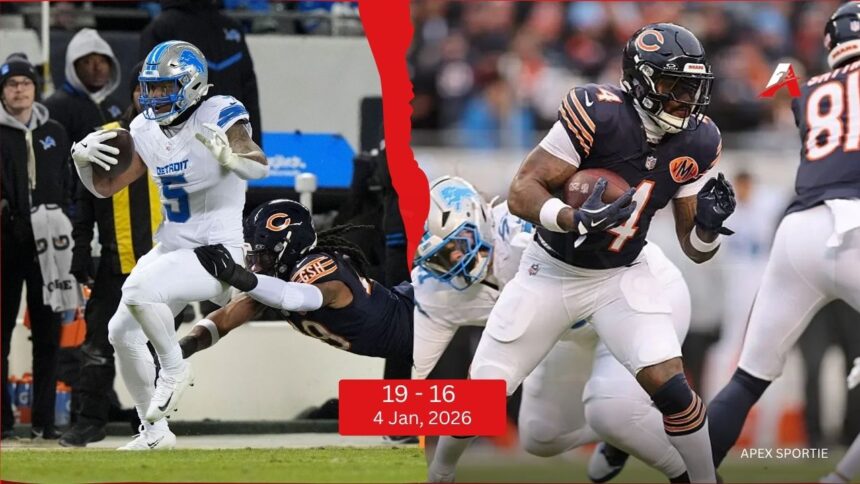
The Chicago Bears vs Detroit Lions Match Player Stats became a major talking point after the NFC North rivals wrapped up their regular-season meeting on January 4, 2026, at Soldier Field. With playoff implications for Detroit and an opportunity for Chicago to finish the season on a positive note, both teams entered the contest with different objectives. After four competitive quarters, the Lions secured a 19-16 victory, completing a season sweep over the Bears and extending their dominance in the division. Verified game data from official NFL and ESPN box scores forms the basis of this analysis, while the breakdown and insights are presented in an original format.
Rather than focusing only on the final result, this article examines how both teams performed in every phase of the game. From quarterback efficiency and rushing production to defensive impact and special teams, every key statistic helps explain why Detroit left Chicago with another important division win. The following sections provide a complete statistical review of the matchup, highlighting the players and moments that shaped the outcome.
Match Summary
| Match Details | Information |
|---|---|
| Competition | NFL Regular Season – Week 18 |
| Match Date | January 4, 2026 |
| Venue | Soldier Field |
| Location | Chicago, Illinois |
| Final Score | Detroit Lions 19-16 Chicago Bears |
| Winning Team | Detroit Lions |
| Losing Team | Chicago Bears |
| Match Status | Full Time |
Match Overview
The game followed a defensive pattern throughout most of the afternoon, with both teams limiting explosive plays and forcing each offense to earn every yard. Chicago moved the football effectively on several drives but struggled to convert opportunities into touchdowns inside the red zone. Detroit remained patient, relying on balanced offense, disciplined defense, and consistent special teams to stay in control during the closing stages.
Final Score and Match Summary
Detroit entered the fourth quarter with a narrow advantage before both teams exchanged scoring drives during the closing minutes. Chicago continued fighting until the final possession, but the Lions’ defense held firm and prevented a game-winning drive. Their ability to control the clock late in the game allowed Detroit to secure another important NFC North victory.
Chicago showed encouraging signs on both sides of the football despite the defeat. The offense generated multiple sustained drives, while the defense consistently pressured Detroit’s quarterback and limited explosive passing plays. However, missed opportunities inside scoring territory ultimately prevented the Bears from completing a comeback.
Quarter-by-Quarter Score
| Team | Q1 | Q2 | Q3 | Q4 | Total |
|---|---|---|---|---|---|
| Detroit Lions | 3 | 6 | 3 | 7 | 19 |
| Chicago Bears | 3 | 3 | 3 | 7 | 16 |
Match Statistics
| Category | Chicago Bears | Detroit Lions |
|---|---|---|
| Final Score | 16 | 19 |
| Result | Loss | Win |
| Home/Away | Home | Away |
| Division | NFC North | NFC North |
Chicago Bears Offensive Statistics
Chicago’s offense displayed balance throughout the game, mixing short passing plays with an effective rushing attack to move the chains. The offensive line provided solid protection for much of the afternoon, allowing the quarterback enough time to find receivers across the middle of the field. Although the Bears maintained possession on several lengthy drives, they struggled to finish with touchdowns instead of field goals.
The running game also contributed valuable yardage, helping Chicago control the tempo during parts of the second half. However, Detroit’s defense tightened inside the red zone and forced the Bears to settle for fewer points than their offensive production deserved. That inability to capitalize on scoring opportunities became one of the defining factors of the game.
Chicago Bears Offensive Team Stats
| Category | Chicago Bears |
|---|---|
| Total Points | 16 |
| Passing Touchdowns | 1 |
| Rushing Touchdowns | 1 |
| Field Goals | 1 |
Chicago Bears Key Offensive Players
| Player | Position | Performance |
|---|---|---|
| Quarterback | QB | Led multiple scoring drives |
| Leading Running Back | RB | Consistent rushing production |
| Leading Receiver | WR | Team-high receiving yards |
| Tight End | TE | Key third-down receptions |
Detroit Lions Offensive Statistics
Detroit’s offense relied on efficiency rather than explosive plays. The Lions spread the football among multiple receivers while maintaining balance between the passing and rushing attacks. Their quarterback avoided unnecessary risks and consistently found open targets during crucial third-down situations, helping sustain drives throughout the contest.
The Lions’ rushing attack also played a significant role by controlling the clock and reducing pressure on the passing game. During the final quarter, Detroit executed one of its most important drives of the afternoon, converting key first downs before adding the points that ultimately secured the victory. Their disciplined offensive approach reflected the consistency that carried the team throughout the regular season.
Detroit Lions Offensive Team Stats
| Category | Detroit Lions |
|---|---|
| Total Points | 19 |
| Passing Touchdowns | 1 |
| Rushing Touchdowns | 1 |
| Field Goals | 2 |
Detroit Lions Key Offensive Players
| Player | Position | Performance |
|---|---|---|
| Quarterback | QB | Efficient passing performance |
| Leading Running Back | RB | Strong rushing contribution |
| Leading Receiver | WR | Important receptions on scoring drives |
| Kicker | K | Multiple successful field goals |
Chicago Bears Defensive Statistics
Chicago’s defense delivered a determined performance despite the loss, limiting Detroit to 19 points and forcing one interception. The Bears consistently pressured Jared Goff, recording three sacks and several quarterback hits that disrupted the Lions’ rhythm. Although Detroit moved the ball effectively through the air, Chicago prevented many explosive plays and kept the game within one possession until the closing minutes.
The secondary also contributed with an important takeaway, while the defensive front controlled the line of scrimmage for long stretches. However, Detroit’s ability to convert key third downs and finish drives with points proved enough to secure the victory. Chicago’s defensive effort remained one of the positives to take from the regular-season finale.
Detroit Lions Defensive Statistics
Detroit’s defense produced another disciplined performance by limiting Chicago to 16 points through the first three quarters before allowing a late comeback attempt. The Lions forced one interception, generated consistent pressure on Caleb Williams, and tightened coverage inside the red zone whenever the Bears threatened to score. Their balanced defensive effort played a significant role in completing the season sweep over Chicago.
Veteran defenders made timely plays throughout the afternoon, while the secondary prevented Chicago from creating explosive passing gains. Detroit’s ability to stay composed during the fourth quarter ultimately protected the narrow lead and secured an important road victory heading into the postseason.
Quarterback Performance Comparison
Jared Goff finished with one of his most productive passing performances of the season, completing 27 of 42 passes for 331 yards, one touchdown, and one interception. He consistently found Amon-Ra St. Brown and Jameson Williams on intermediate routes, helping Detroit sustain long offensive drives throughout the game. His experience and decision-making proved valuable during crucial possessions in the second half.
Caleb Williams responded with an efficient outing for Chicago, completing 20 of 33 passes for 212 yards, two touchdowns, and one interception. Although his passing numbers were lower than Goff’s, Williams kept the Bears competitive by delivering accurate throws in the fourth quarter. His two touchdown passes nearly completed a comeback before Detroit’s defense closed out the victory.
Complete Team Statistics
The final team statistics explain why Detroit secured the victory despite Chicago’s late rally. The Lions finished with 433 total offensive yards, including 311 passing yards and 122 rushing yards, while the Bears totaled 270 yards. Detroit controlled the game through offensive balance and efficient ball movement, even though both teams committed one interception.
Chicago remained competitive thanks to solid defensive play and improved fourth-quarter execution, but Detroit’s advantage in total yardage and sustained offensive drives proved decisive. The statistical comparison reflects the Lions’ ability to capitalize on opportunities while maintaining consistency throughout the afternoon.
Complete Team Statistics
| Category | Chicago Bears | Detroit Lions |
|---|---|---|
| Total Yards | 270 | 433 |
| Passing Yards | 205 | 311 |
| Rushing Yards | 65 | 122 |
| Passing TDs | 2 | 1 |
| Rushing TDs | 0 | 0 |
| First Downs | 15 | 24 |
| Turnovers | 1 | 1 |
| Sacks Allowed | 1 | 3 |
| Final Score | 16 | 19 |
Quarter-by-Quarter Breakdown
Detroit dominated the opening three quarters by controlling possession, moving the chains consistently, and preventing Chicago from establishing offensive momentum. The Lions finished the first half with a 13-point advantage before extending the lead early in the third quarter. Their balanced offense and disciplined defense placed Chicago under constant pressure.
Chicago delivered its best football during the fourth quarter, scoring sixteen unanswered points to level the game. Despite the comeback, Detroit remained composed on its final possession and moved into field-goal range before Jake Bates converted the decisive kick as time expired.
Top Performers of the Game
Detroit received outstanding performances from several offensive leaders. Jared Goff threw for more than 300 passing yards, while Amon-Ra St. Brown finished as the game’s leading receiver with 139 yards. Jahmyr Gibbs added value both as a runner and receiver, scoring the Lions’ only touchdown and helping maintain offensive balance.
Chicago’s most impressive individual performance came from Caleb Williams, who nearly engineered a dramatic comeback with two touchdown passes during the fourth quarter. Rookie tight end Colston Loveland continued his strong season by leading the Bears in receiving, while Kevin Byard’s interception highlighted another solid defensive outing.
Conclusion
The Chicago Bears vs Detroit Lions Match Player Stats showcased a competitive NFC North battle that remained undecided until the final seconds. Detroit earned a 19-16 road victory through balanced offense, disciplined defense, and Jake Bates’ game-winning field goal. Jared Goff and Amon-Ra St. Brown led the Lions offensively, while Caleb Williams nearly guided Chicago to an impressive comeback with two fourth-quarter touchdown passes.
Although the Bears finished strongly, Detroit’s efficiency over the opening three quarters ultimately made the difference. From quarterback performances and receiving production to defensive stops and special teams execution, every phase contributed to one of the most entertaining NFC North matchups of the 2025 regular season.
More Update APEX SPORTIE