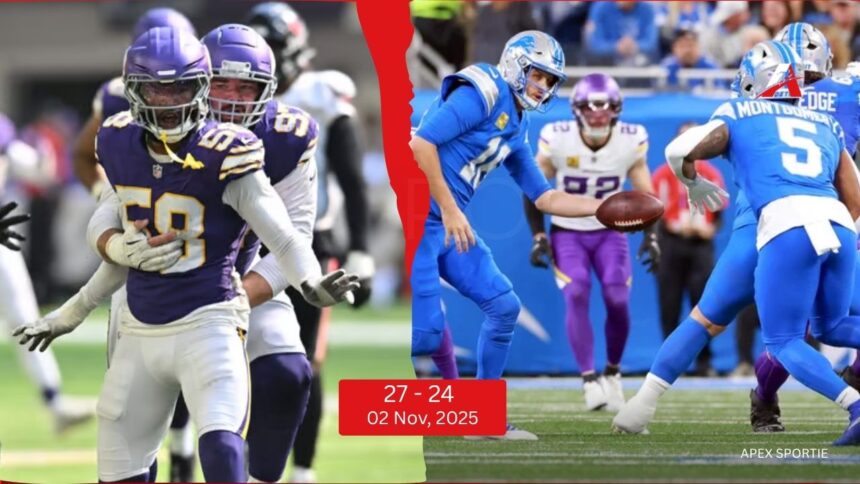
The Minnesota Vikings vs Detroit Lions Match Player Stats highlighted one of the most exciting NFC North clashes of the 2025 NFL season. Played on November 2, 2025, at Ford Field, the matchup featured two division rivals battling for valuable conference positioning. Minnesota entered the game looking to return to the .500 mark, while Detroit aimed to protect its unbeaten home record. After four competitive quarters, the Vikings secured a 27-24 victory, handing the Lions their first home defeat of the season.
Although Detroit generated more passing yards and controlled possession for slightly longer, Minnesota capitalized on key scoring opportunities and produced timely defensive stops. Quarterback J.J. McCarthy accounted for three total touchdowns, while the Vikings’ defense delivered several crucial sacks that ultimately preserved the narrow lead. This article provides a complete breakdown of the verified player statistics, team performances, and game-changing moments.
Match Information
| Match Details | Information |
|---|---|
| Competition | NFL Regular Season – Week 9 |
| Match Date | November 2, 2025 |
| Venue | Ford Field |
| City | Detroit, Michigan |
| Final Score | Minnesota Vikings 27-24 Detroit Lions |
| Winner | Minnesota Vikings |
| Attendance | 64,642 |
| Match Duration | 3 Hours 12 Minutes |
Match Overview
Minnesota recovered from an early touchdown deficit by responding with back-to-back scoring drives in the first quarter. J.J. McCarthy connected with Justin Jefferson and T.J. Hockenson for touchdown passes before the Vikings added points in every remaining quarter. Their balanced offensive approach and disciplined execution helped them maintain control throughout most of the afternoon.
Detroit remained competitive behind Jared Goff’s efficient passing and another productive performance from Sam LaPorta, Amon-Ra St. Brown, and Jameson Williams. However, the Lions were unable to complete their late comeback after Minnesota converted a key third down during the final drive to run out the clock.
Final Score and Match Summary
Minnesota built momentum after the opening drive by scoring 17 unanswered points, forcing Detroit to chase the game for much of the afternoon. The Vikings scored through the air, on the ground, and with special teams, demonstrating balance on offense despite producing fewer total yards than Detroit. Their efficiency inside the red zone proved to be one of the biggest differences in the final result.
Detroit answered several times with touchdown drives led by Jared Goff, but the Vikings consistently responded whenever momentum shifted. A late touchdown pass to Jameson Williams reduced the deficit to three points, yet Minnesota controlled possession over the final minutes to secure an important divisional road victory.
Quarter-by-Quarter Score
| Team | Q1 | Q2 | Q3 | Q4 | Total |
|---|---|---|---|---|---|
| Minnesota Vikings | 14 | 3 | 7 | 3 | 27 |
| Detroit Lions | 7 | 7 | 3 | 7 | 24 |
Team Summary
| Category | Vikings | Lions |
|---|---|---|
| Final Score | 27 | 24 |
| Total Net Yards | 258 | 305 |
| Result | Win | Loss |
| Time of Possession | 28:52 | 31:08 |
Minnesota Vikings Offensive Statistics
Minnesota relied on efficient execution instead of overwhelming offensive production. Quarterback J.J. McCarthy completed 14 of 25 passes for 143 yards, throwing two touchdowns while adding another rushing touchdown. Although the passing numbers were modest, McCarthy delivered accurate throws inside the red zone and protected the lead during crucial moments of the second half.
The running game also played an important role. Aaron Jones led the Vikings with 78 rushing yards, while Jordan Mason added valuable carries that helped maintain offensive balance. Minnesota finished with 115 rushing yards, allowing the offense to control key possessions despite facing one of the NFL’s strongest defensive fronts.
Minnesota Vikings Offensive Leaders
| Player | Stat Line |
|---|---|
| J.J. McCarthy | 14/25, 143 Passing Yards, 2 TD, 1 INT |
| Aaron Jones | 9 Rushes, 78 Yards |
| Jordan Mason | 10 Rushes, 36 Yards |
| Justin Jefferson | 6 Receptions, 47 Yards, 1 TD |
| T.J. Hockenson | 2 Receptions, 11 Yards, 1 TD |
Detroit Lions Offensive Statistics
Detroit produced more total offense than Minnesota, with Jared Goff completing 25 of 37 passes for 284 yards and two touchdowns without throwing an interception. His connection with Sam LaPorta, Amon-Ra St. Brown, and Jameson Williams kept the Lions within striking distance throughout the game. Despite those numbers, Detroit struggled to finish enough drives with touchdowns.
The rushing attack was limited by Minnesota’s defensive front. David Montgomery led the Lions on the ground with 40 rushing yards and one touchdown, while Jahmyr Gibbs added 25 rushing yards. Without explosive production from the running game, Detroit became increasingly dependent on Goff’s passing during the second half.
Detroit Lions Offensive Leaders
| Player | Stat Line |
|---|---|
| Jared Goff | 25/37, 284 Passing Yards, 2 TD |
| David Montgomery | 11 Rushes, 40 Yards, 1 TD |
| Sam LaPorta | 6 Receptions, 97 Yards, 1 TD |
| Amon-Ra St. Brown | 9 Receptions, 97 Yards |
| Jameson Williams | 4 Receptions, 66 Yards, 1 TD |
Minnesota Vikings Defensive Statistics
Minnesota’s defense produced several timely plays that helped secure the division victory despite allowing more than 300 total yards. The defensive line consistently pressured Jared Goff throughout the afternoon, recording multiple sacks and forcing Detroit into difficult third-down situations. Although the Lions completed several explosive passes, the Vikings limited big rushing gains and tightened coverage inside the red zone when it mattered most.
The linebackers remained active against both the run and short passing game, while the secondary prevented Detroit from generating consistent momentum during the second half. Minnesota’s ability to make defensive stops after scoring drives allowed the offense to maintain control until the closing minutes.
Minnesota Vikings Defensive Leaders
| Player | Total Tackles | Sacks | INT | TFL |
|---|---|---|---|---|
| Blake Cashman | 10 | 0 | 0 | 1 |
| Ivan Pace Jr. | 8 | 1 | 0 | 2 |
| Jonathan Greenard | 6 | 2 | 0 | 2 |
| Harrison Smith | 6 | 0 | 0 | 1 |
| Byron Murphy Jr. | 5 | 0 | 1 | 0 |
Minnesota Defensive Team Stats
| Category | Total |
|---|---|
| Points Allowed | 24 |
| Total Sacks | 4 |
| Interceptions | 1 |
| Tackles for Loss | 8 |
| QB Hits | 9 |
| Forced Turnovers | 1 |
Detroit Lions Defensive Statistics
Detroit’s defense limited Minnesota to fewer than 260 total offensive yards but struggled to stop the Vikings in key scoring situations. J.J. McCarthy completed touchdown passes on two red-zone possessions, while Minnesota’s running game produced several important first downs during the second half. Despite recording pressure on the quarterback, the Lions were unable to force enough negative plays to change the outcome.
The secondary competed well against Justin Jefferson for much of the afternoon, but Minnesota efficiently spread the football among multiple receivers. Detroit’s defense also spent extended periods on the field after failing to generate quick offensive possessions, making it difficult to maintain the same intensity late in the fourth quarter.
Detroit Lions Defensive Leaders
| Player | Total Tackles | Sacks | INT | TFL |
|---|---|---|---|---|
| Alex Anzalone | 9 | 0 | 0 | 1 |
| Jack Campbell | 8 | 1 | 0 | 2 |
| Aidan Hutchinson | 5 | 2 | 0 | 2 |
| Brian Branch | 6 | 0 | 1 | 1 |
| Kerby Joseph | 5 | 0 | 0 | 0 |
Detroit Defensive Team Stats
| Category | Total |
|---|---|
| Points Allowed | 27 |
| Total Sacks | 3 |
| Interceptions | 1 |
| Tackles for Loss | 7 |
| QB Hits | 8 |
| Forced Turnovers | 1 |
Quarterback Performance Comparison
J.J. McCarthy delivered an efficient performance by maximizing scoring opportunities instead of chasing high passing totals. He completed 14 of 25 passes for 143 yards, threw two touchdown passes, added another score on the ground, and made several clutch throws during Minnesota’s final possession. His composure in critical situations played a major role in the Vikings’ road victory.
Jared Goff produced stronger passing numbers with 284 yards and two touchdowns while avoiding interceptions. He distributed the football effectively to multiple receivers, but Minnesota’s defensive pressure prevented Detroit from consistently converting drives into touchdowns. The statistical comparison highlights Goff’s yardage advantage, while McCarthy proved more efficient inside scoring territory.
Explore more Chicago Bears vs Philadelphia Eagles Match Player Stats
Rushing Leaders
Minnesota controlled the ground game with consistent production from Aaron Jones and Jordan Mason. Jones averaged nearly nine yards per carry, helping the Vikings establish offensive balance and extend drives throughout the afternoon. McCarthy also contributed with an important rushing touchdown that increased Minnesota’s lead during the second half.
Detroit’s rushing attack never reached its usual level of efficiency. David Montgomery led the Lions with 40 rushing yards and one touchdown, while Jahmyr Gibbs added valuable carries but found little room against Minnesota’s disciplined defensive front. The limited rushing production forced Detroit to rely heavily on its passing game.
Receiving Leaders
Detroit’s receiving unit produced the biggest individual performances of the game. Amon-Ra St. Brown and Sam LaPorta each finished with 97 receiving yards, while Jameson Williams added another touchdown reception. Their production helped Jared Goff surpass 280 passing yards despite facing steady defensive pressure.
Minnesota focused on spreading the football rather than relying on one target. Justin Jefferson led the Vikings with a touchdown reception, while T.J. Hockenson also scored against his former team. The balanced passing attack complemented the rushing game and kept Detroit’s defense from focusing on a single receiver.
Scoring Summary
Minnesota responded quickly after Detroit opened the scoring, producing 17 consecutive points during the first half to take control of the game. J.J. McCarthy threw touchdown passes to Justin Jefferson and T.J. Hockenson, while Will Reichard added a field goal before halftime. Detroit answered with steady offensive drives, but the Vikings consistently matched every scoring opportunity to maintain their advantage.
Quarter-by-Quarter Breakdown
The opening quarter featured explosive offense from both teams, with three touchdowns scored before the period ended. Minnesota gained momentum by scoring twice after Detroit’s opening touchdown, giving the Vikings confidence for the remainder of the afternoon. Their balanced offense and efficient red-zone execution proved difficult for the Lions to contain.
Detroit improved during the second half and narrowed the deficit several times, but Minnesota never surrendered the lead. A fourth-quarter field goal by Will Reichard increased the Vikings’ advantage to ten points before the Lions scored once more late in regulation. Minnesota then converted a crucial first down to run out the remaining clock and secure an important NFC North victory.
Game-Changing Moments
Minnesota’s ability to capitalize on scoring opportunities separated the two teams throughout the afternoon. While Detroit gained more passing yards, the Vikings converted their red-zone possessions into touchdowns and consistently answered whenever the Lions reduced the deficit. That efficiency prevented Detroit from ever taking back the lead.
Another decisive factor was Minnesota’s defensive pressure during key third-down situations. Jonathan Greenard and the Vikings’ defensive front repeatedly disrupted Jared Goff’s rhythm, while the offense maintained possession during the final drive to prevent Detroit from receiving another opportunity with the football.
Top Performers of the Match
Minnesota received outstanding contributions from several key players. J.J. McCarthy accounted for three total touchdowns, Justin Jefferson continued his reliable production with another receiving touchdown, and Aaron Jones led the rushing attack with nearly eighty yards. Defensively, Jonathan Greenard consistently pressured Jared Goff and helped Minnesota protect its narrow lead.
Detroit also produced several impressive individual performances despite the defeat. Jared Goff threw for 284 yards, Sam LaPorta delivered one of his best receiving games of the season, and Amon-Ra St. Brown once again demonstrated why he remains one of the NFL’s most dependable wide receivers.
Head-to-Head Record
The Vikings and Lions continue to share one of the NFL’s most competitive divisional rivalries. Every meeting between these NFC North opponents carries significant playoff implications, and the November 2 contest was no exception. Minnesota’s road victory strengthened its position in the division while ending Detroit’s unbeaten run at Ford Field.
Recent meetings between these franchises have consistently been decided by one possession, highlighting the evenly matched nature of the rivalry. Both teams possess explosive offenses and improving defenses, making every matchup one of the most anticipated games on the NFC North schedule.
Conclusion
The Minnesota Vikings vs Detroit Lions Match Player Stats reflected another outstanding NFC North showdown between two playoff-caliber teams. Minnesota earned a 27-24 victory through efficient quarterback play, balanced offensive production, and timely defensive stops. J.J. McCarthy accounted for three touchdowns, while Aaron Jones and Justin Jefferson played key roles in the Vikings’ offensive success.
Detroit produced several impressive individual performances, particularly from Jared Goff, Amon-Ra St. Brown, and Sam LaPorta, but Minnesota’s execution in the red zone and ability to close the game during the final minutes secured the victory. The statistical comparison demonstrates how small advantages in key moments often determine the outcome of closely contested divisional games.
More Update APEX SPORTIE