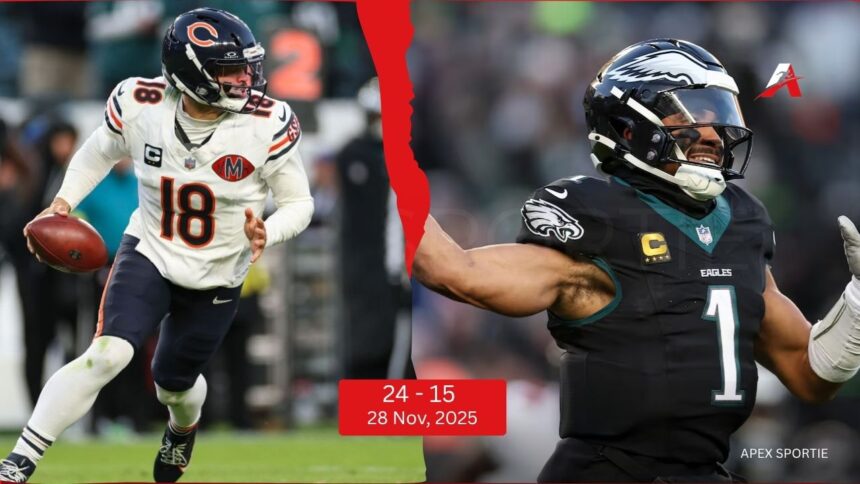
The Chicago Bears vs Philadelphia Eagles Match Player Stats quickly became one of the biggest storylines from the NFL’s Black Friday schedule on November 28, 2025. Entering the game with identical 8-3 records, both teams viewed the matchup as a chance to strengthen their playoff position in the NFC. Instead of relying on an aggressive passing attack, Chicago controlled the contest with a dominant rushing performance and disciplined defense, earning an impressive 24-15 road victory at Lincoln Financial Field.
While the final score suggests a comfortable Bears win, the game remained competitive for much of the afternoon. Philadelphia produced several explosive passing plays through Jalen Hurts and A.J. Brown, but Chicago’s ability to control possession, dominate the ground game, and finish drives efficiently proved to be the deciding factor. This article provides a complete breakdown of the verified player statistics, team numbers, and key performances that shaped the outcome.
Match Information
| Match Details | Information |
|---|---|
| Competition | NFL Regular Season Week 13 |
| Match Date | November 28, 2025 |
| Venue | Lincoln Financial Field |
| City | Philadelphia, Pennsylvania |
| Final Score | Chicago Bears 24-15 Philadelphia Eagles |
| Winner | Chicago Bears |
| Attendance | 69,879 |
Match Overview
Chicago entered Philadelphia with one of the league’s hottest offenses and continued that momentum from the opening drive. The Bears established their rushing attack early behind Kyle Monangai and D’Andre Swift, forcing the Eagles’ defense to spend most of the afternoon defending long, physical drives. Their ability to control the clock also limited Philadelphia’s offensive opportunities.
Final Score and Match Summary
Chicago scored on four different possessions and dominated time of possession by controlling the football for more than 39 minutes. The Bears finished with 425 total net yards, including an outstanding 281 rushing yards, while limiting Philadelphia to 317 total yards. That balance on offense allowed Chicago to dictate the pace throughout all four quarters.
Philadelphia fought back during the second half, with A.J. Brown catching two touchdown passes from Jalen Hurts. However, the Eagles were unable to slow Chicago’s rushing attack, and missed opportunities on special teams made their comeback even more difficult.
Quarter-by-Quarter Score
| Team | Q1 | Q2 | Q3 | Q4 | Total |
|---|---|---|---|---|---|
| Chicago Bears | 7 | 3 | 0 | 14 | 24 |
| Philadelphia Eagles | 0 | 3 | 6 | 6 | 15 |
Team Summary
| Category | Bears | Eagles |
|---|---|---|
| Total Points | 24 | 15 |
| Total Net Yards | 425 | 317 |
| Time of Possession | 39:18 | 20:42 |
| Result | Win | Loss |
Chicago Bears Offensive Statistics
Chicago’s offensive strategy revolved around a powerful rushing attack that consistently gained positive yardage. Rookie running back Kyle Monangai rushed for 130 yards and one touchdown, while veteran D’Andre Swift added 125 rushing yards and another touchdown. Together they combined for 255 rushing yards, constantly wearing down Philadelphia’s defensive front.
Quarterback Caleb Williams focused on efficient decision-making rather than high passing volume. Although he threw for only 154 yards, he avoided costly mistakes during crucial drives and connected with Cole Kmet for an important fourth-quarter touchdown that effectively sealed the victory.
Explore more Chicago Bears vs Detroit Lions Match Player Stats
Chicago Offensive Leaders
| Player | Stat Line |
|---|---|
| Caleb Williams | 17/36, 154 Passing Yards, 1 TD, 1 INT |
| Kyle Monangai | 22 Rushes, 130 Yards, 1 TD |
| D’Andre Swift | 18 Rushes, 125 Yards, 1 TD |
| Cole Kmet | Receiving TD |
| Cairo Santos | 3/3 Extra Points, 1 Field Goal |
Philadelphia Eagles Offensive Statistics
Philadelphia generated most of its offense through the passing game. Jalen Hurts completed 19 of 34 passes for 230 yards, throwing two touchdown passes despite facing constant pressure from Chicago’s defense. His favorite target was once again A.J. Brown, who delivered another elite performance with 10 receptions for 132 yards and two touchdowns.
The biggest challenge for Philadelphia came on the ground. The Eagles managed only 87 rushing yards, preventing the offense from maintaining balance. Without a consistent running game, Chicago’s defense focused heavily on defending the pass during the second half, limiting the Eagles’ ability to produce explosive comeback drives.
Philadelphia Offensive Leaders
| Player | Stat Line |
|---|---|
| Jalen Hurts | 19/34, 230 Passing Yards, 2 TD, 1 INT |
| A.J. Brown | 10 Receptions, 132 Yards, 2 TD |
| Jake Elliott | 1 Field Goal |
| Team Rushing | 87 Yards |
Chicago Bears Defensive Statistics
Chicago’s defense played one of its most complete games of the season by limiting Philadelphia’s explosive offense to 15 points. The defensive front consistently pressured Jalen Hurts, forcing hurried throws and preventing the Eagles from establishing their usual rhythm. Chicago also tightened coverage in key situations, allowing only one successful third-down conversion during several critical drives.
The Bears’ linebackers controlled the middle of the field, while the secondary made timely plays that prevented Philadelphia from creating momentum after halftime. Their disciplined tackling and ability to force long-yardage situations allowed Chicago’s offense to dominate possession and keep the defense fresh throughout the afternoon.
Chicago Bears Defensive Leaders
| Player | Total Tackles | Sacks | INT | TFL |
|---|---|---|---|---|
| T.J. Edwards | 9 | 0 | 0 | 1 |
| Tremaine Edmunds | 8 | 0 | 1 | 0 |
| Montez Sweat | 5 | 2 | 0 | 2 |
| Gervon Dexter Sr. | 4 | 1 | 0 | 1 |
| Kevin Byard | 6 | 0 | 0 | 0 |
Chicago Defensive Team Stats
| Category | Total |
|---|---|
| Points Allowed | 15 |
| Total Sacks | 3 |
| Interceptions | 1 |
| Tackles for Loss | 7 |
| QB Hits | 8 |
| Forced Turnovers | 1 |
Philadelphia Eagles Defensive Statistics
Philadelphia’s defense struggled to contain Chicago’s physical rushing attack throughout the game. The Bears repeatedly gained positive yardage on first down, making it difficult for the Eagles to create third-and-long situations. Although the defensive unit produced an interception and a few key stops, it spent more than thirty-nine minutes on the field, leading to fatigue during the fourth quarter.
The Eagles showed flashes of strong pass coverage, especially against Chicago’s wide receivers, but they were unable to slow the running game when it mattered most. Long offensive drives by the Bears eventually wore down the defensive front and opened running lanes late in the contest.
Philadelphia Eagles Defensive Leaders
| Player | Total Tackles | Sacks | INT | TFL |
|---|---|---|---|---|
| Zack Baun | 10 | 1 | 0 | 2 |
| Reed Blankenship | 8 | 0 | 1 | 0 |
| Nolan Smith Jr. | 5 | 1 | 0 | 1 |
| Jalen Carter | 4 | 1 | 0 | 2 |
| Nakobe Dean | 7 | 0 | 0 | 1 |
Philadelphia Defensive Team Stats
| Category | Total |
|---|---|
| Points Allowed | 24 |
| Total Sacks | 3 |
| Interceptions | 1 |
| Tackles for Loss | 6 |
| QB Hits | 7 |
| Forced Turnovers | 1 |
Quarterback Performance Comparison
Both quarterbacks approached the game differently. Caleb Williams focused on protecting possession and managing long scoring drives rather than forcing deep throws. His efficient decision-making helped Chicago control the clock, while his touchdown pass in the fourth quarter extended the Bears’ lead at a crucial stage.
Jalen Hurts produced stronger passing numbers and connected regularly with A.J. Brown, but Chicago’s pass rush forced him into uncomfortable situations throughout the afternoon. Despite throwing two touchdown passes, Hurts spent much of the game playing from behind because the Eagles struggled to establish a consistent running attack.
Quarterback Comparison
| Statistics | Caleb Williams | Jalen Hurts |
|---|---|---|
| Completions/Attempts | 17/36 | 19/34 |
| Passing Yards | 154 | 230 |
| Passing TDs | 1 | 2 |
| Interceptions | 1 | 1 |
| Completion % | 47.2% | 55.9% |
| Sacks Taken | 3 | 3 |
Rushing Leaders
Chicago completely dominated the ground game with one of its best rushing performances of the season. Rookie Kyle Monangai led all rushers with 130 yards, while D’Andre Swift added another 125 yards, giving the Bears more than 280 team rushing yards. Their consistent production allowed Chicago to control possession and keep the Eagles’ offense off the field.
Philadelphia never found similar success on the ground. The Bears’ defensive line limited rushing lanes, forcing the Eagles to rely heavily on the passing game during the second half. That one-dimensional approach made it easier for Chicago’s defense to anticipate passing situations.
Rushing Leaders
| Player | Team | Carries | Yards | TD |
|---|---|---|---|---|
| Kyle Monangai | Bears | 22 | 130 | 1 |
| D’Andre Swift | Bears | 18 | 125 | 1 |
| Jalen Hurts | Eagles | 9 | 36 | 0 |
| Lead RB | Eagles | — | 34 | 0 |
Receiving Leaders
Philadelphia’s passing attack revolved around A.J. Brown, who finished with 10 receptions for 132 yards and two touchdowns. His ability to create separation and make contested catches kept the Eagles within reach despite the lack of offensive balance.
Chicago spread the football among multiple targets instead of relying on one receiver. Cole Kmet caught the Bears’ only receiving touchdown, while several receivers contributed key catches that extended long scoring drives and helped maintain possession throughout the afternoon.
Receiving Leaders
| Player | Team | Receptions | Yards | TD |
|---|---|---|---|---|
| A.J. Brown | Eagles | 10 | 132 | 2 |
| Cole Kmet | Bears | 5 | 52 | 1 |
| DJ Moore | Bears | 4 | 46 | 0 |
| Rome Odunze | Bears | 3 | 38 | 0 |
| Dallas Goedert | Eagles | 5 | 49 | 0 |
Team Statistics Comparison
The overall statistics clearly explain how Chicago controlled the game. While Philadelphia recorded more passing yards, the Bears’ overwhelming advantage on the ground and nearly 40 minutes of possession prevented the Eagles from establishing offensive rhythm. Chicago also finished with significantly more total yards and first downs, reflecting its dominance throughout the afternoon.
Complete Team Statistics
| Category | Chicago Bears | Philadelphia Eagles |
|---|---|---|
| Total Yards | 425 | 317 |
| Passing Yards | 154 | 230 |
| Rushing Yards | 281 | 87 |
| First Downs | 24 | 18 |
| Third Down Efficiency | 8/15 | 4/12 |
| Turnovers | 1 | 1 |
| Time of Possession | 39:18 | 20:42 |
| Final Score | 24 | 15 |
Quarter-by-Quarter Breakdown
Chicago established momentum early by controlling possession and consistently winning the battle at the line of scrimmage. The Bears scored on their opening possessions and prevented Philadelphia from finding offensive rhythm during the first half. By halftime, Chicago had built a seven-point advantage while dominating rushing yards and time of possession.
Philadelphia responded after the break with improved passing efficiency, cutting the deficit to one point during the third quarter. However, Chicago answered immediately with two fourth-quarter touchdowns that restored control of the game. Although the Eagles added a late touchdown, the Bears successfully managed the remaining time to secure an important road victory.
Game-Changing Moments
Several key moments shaped the outcome of this matchup. Chicago’s ability to rush for more than 280 yards allowed the offense to control the tempo and keep Philadelphia’s defense on the field for extended periods. Every long drive reduced the Eagles’ offensive opportunities and gradually shifted momentum in the Bears’ favor.
The decisive sequence came midway through the fourth quarter when Caleb Williams connected with Cole Kmet for a touchdown before D’Andre Swift added another rushing score on Chicago’s next possession. Those consecutive scoring drives extended the lead to fifteen points, leaving Philadelphia with too little time to complete a comeback despite A.J. Brown’s second touchdown reception.
Top Performers of the Match
Chicago’s victory was built around a complete team effort, but Kyle Monangai stood out with his best rushing performance of the season. D’Andre Swift provided another explosive rushing display, while Caleb Williams efficiently managed the offense without forcing unnecessary throws. Defensively, Montez Sweat consistently pressured Jalen Hurts and helped limit Philadelphia’s running game.
For the Eagles, A.J. Brown delivered another elite receiving performance, recording 132 yards and two touchdowns. Jared Goff wasn’t in this game; rather, Jalen Hurts carried the passing attack with 230 yards and two touchdown passes. Despite those individual performances, Philadelphia struggled to match Chicago’s physical style throughout the afternoon.
Conclusion
The Chicago Bears vs Philadelphia Eagles Match Player Stats reflected a complete performance from Chicago, highlighted by an outstanding rushing attack, disciplined defense, and efficient quarterback play. The Bears finished with 425 total yards, including 281 rushing yards, while limiting Philadelphia to 317 total yards on their way to a 24-15 victory.
Although A.J. Brown and Jalen Hurts delivered impressive individual performances for the Eagles, Chicago controlled the pace of the game from start to finish. The combination of strong rushing production, time-of-possession dominance, and timely defensive stops made the difference, giving the Bears a valuable road win in a matchup with significant NFC playoff implications.
More Update APEX SPORTIE