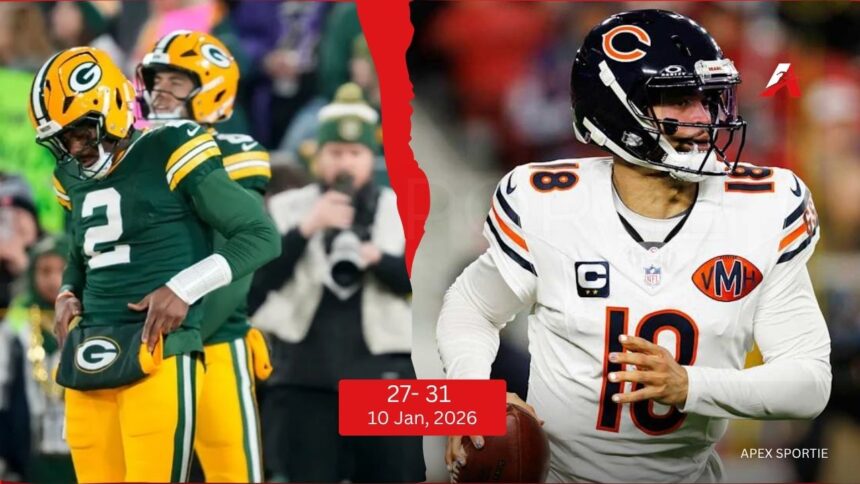
Few rivalries in the NFL match the history and intensity shared by the Green Bay Packers and the Chicago Bears. When these two NFC North rivals met in the Wild Card Round on January 10, 2026, expectations were already sky-high because of their long-standing competition and playoff implications. The matchup featured talented quarterbacks, experienced veterans, and rising young stars eager to leave their mark on one of football’s oldest rivalries. Fans expected a close contest, but few predicted the dramatic finish that unfolded during the final quarter.
The game began with Green Bay controlling much of the first half through efficient offensive execution and smart decision-making. Jordan Love directed multiple scoring drives, helping the Packers establish what looked like a comfortable lead before halftime. However, Chicago never abandoned its game plan. Led by quarterback Caleb Williams, the Bears slowly regained confidence, adjusted offensively, and produced one of the biggest fourth-quarter comebacks of the postseason. The final score of Chicago Bears 31, Green Bay Packers 27 reflected not only an exciting playoff battle but also the importance of resilience, coaching adjustments, and execution under pressure.
Match Quick Score Table
| Team | 1 | 2 | 3 | 4 | Final |
|---|---|---|---|---|---|
| Green Bay Packers | 7 | 14 | 0 | 6 | 27 |
| Chicago Bears | 3 | 0 | 3 | 25 | 31 |
First Half Analysis Packers Build
Green Bay looked composed from the opening drive and quickly answered Chicago’s early field goal with an impressive touchdown drive. Jordan Love spread the football efficiently across multiple receivers, forcing the Bears’ secondary to defend every part of the field. Christian Watson opened the touchdown scoring for Green Bay before Jayden Reed and Romeo Doubs each added receiving touchdowns in the second quarter. By halftime, the Packers had built a commanding 21–3 advantage, leaving Chicago with significant work to do after the break.
The Bears struggled offensively during the first two quarters despite moving the football at times. Caleb Williams faced consistent pressure while Green Bay’s defense limited explosive plays and forced Chicago into longer third-down situations. Although the Bears managed to create occasional positive gains, they repeatedly stalled before reaching the end zone. The Packers appeared to control momentum in every phase of the game, including field position and offensive rhythm, making their halftime lead look even more convincing than the scoreboard suggested.
Chicago’s Incredible Second-Half Comeback
Everything changed after halftime as Chicago’s coaching staff adjusted its offensive approach. Rather than forcing deep throws on every possession, Caleb Williams relied on quicker decisions, shorter completions, and improved rhythm passing. The Bears first reduced the deficit with another Cairo Santos field goal before gradually finding opportunities against Green Bay’s secondary. Each successful drive increased Chicago’s confidence while placing additional pressure on the Packers to respond.
The fourth quarter became one of the most memorable periods of the postseason. Chicago exploded for 25 points, turning a seemingly comfortable Packers victory into an unforgettable comeback. D’Andre Swift scored on the ground before Olamide Zaccheaus added another touchdown reception. With less than two minutes remaining, Caleb Williams connected with DJ Moore on the game-winning touchdown pass that completed the comeback and sent Soldier Field into celebration. The Bears’ ability to remain patient despite trailing by eighteen points demonstrated remarkable composure under playoff pressure.
Related article Detroit Lions vs Green Bay Packers Match Player Stats
Quarterback Performance Comparison
Jordan Love delivered one of his strongest statistical performances of the season despite ending on the losing side. He completed 24 of 46 passes for 323 yards and four touchdown passes, consistently attacking the Bears’ defense throughout the first half. His chemistry with Christian Watson, Jayden Reed, Romeo Doubs, and Matthew Golden created problems for Chicago’s secondary and allowed Green Bay to build an early lead.
Caleb Williams experienced a much different game. The young quarterback struggled early and threw two interceptions, but he never allowed those mistakes to define his performance. Instead, he responded with poise during the second half, finishing 24 completions on 48 attempts for 361 passing yards and two touchdowns while engineering the decisive comeback.
Receiving Leaders Who Changed the Game
The Green Bay Packers produced an impressive passing performance, and much of that success came from the production of their receiving unit. Jordan Love distributed the football to multiple targets, preventing Chicago from focusing on a single receiver. Christian Watson opened the scoring with an early touchdown reception, while Jayden Reed and Romeo Doubs added touchdowns of their own. Matthew Golden also made valuable catches that helped extend drives and keep the offense moving.
Chicago’s receiving corps became the difference-maker after halftime. DJ Moore emerged as the game’s biggest playmaker by catching the decisive touchdown pass during the closing minutes. Olamide Zaccheaus added another critical touchdown reception, while the Bears’ tight ends and slot receivers contributed with important third-down conversions. Rather than relying on explosive plays alone, Chicago gradually moved the chains with accurate short and intermediate passes.
Ground Game Comparison Between Both Teams
Although the passing attacks received most of the attention, the running game remained an important factor for both offenses. Green Bay attempted to establish balance by mixing inside runs with outside zone plays. Their running backs gained valuable yards early, preventing Chicago from committing entirely to pass coverage.
Chicago relied heavily on D’Andre Swift during the second half, especially after recognizing that Green Bay’s defense had begun focusing almost exclusively on stopping the passing attack. Swift delivered several timely runs, including an important rushing touchdown that energized both teammates and the home crowd.
Defensive Units Under Pressure
Green Bay’s defense looked outstanding during the opening two quarters. The defensive front consistently pressured Caleb Williams, forcing hurried throws and disrupting Chicago’s offensive rhythm. Linebackers played aggressively against the run, while the secondary successfully limited explosive passing plays. Two interceptions highlighted the unit’s early effectiveness, and at halftime it appeared the Packers’ defense was in complete control of the game.
The second half told a completely different story. Chicago’s offense adjusted its protection schemes, giving Williams more time inside the pocket. As the Bears increased their tempo, Green Bay’s defense struggled to maintain the same level of pressure.
Statistical Comparison That Defined the Outcome
One of the most interesting aspects of this playoff matchup was how statistics reflected momentum shifts rather than complete dominance by one team. Green Bay generated over 300 passing yards, scored four offensive touchdowns, and appeared in complete control during the first half. However, football games are decided over sixty minutes, and Chicago gradually improved in nearly every statistical category after halftime.
While Jordan Love finished with four touchdown passes, Caleb Williams produced more passing yards and engineered the decisive late scoring drives. Chicago’s offensive efficiency during the fourth quarter outweighed Green Bay’s early production.
Biggest Turning Points of the Match
The first major turning point arrived midway through the third quarter when Chicago finally established offensive rhythm and reduced the scoring gap. Instead of forcing risky deep passes, the Bears emphasized shorter completions and steady drives. That strategic adjustment allowed the offense to stay on the field longer and slowly shift momentum away from Green Bay. Confidence grew with every successful possession, while the Packers became increasingly defensive in their approach.
The defining moment occurred late in the fourth quarter when Caleb Williams connected with DJ Moore for the game-winning touchdown. That play completed one of the biggest comebacks of the postseason and erased what had once been an eighteen-point deficit. Green Bay still had time to respond, but Chicago’s defense held firm during the final possession, securing a dramatic playoff victory that will be remembered for years by fans of both franchises.
Conclusion
The Green Bay Packers vs Chicago Bears Match Player Stats showcased why this historic NFL rivalry continues to captivate football fans. Green Bay appeared to have complete control after building an 18-point lead behind Jordan Love’s outstanding four-touchdown performance and an efficient offensive display. However, the Bears refused to back down and produced an incredible second-half comeback led by Caleb Williams, whose poise and leadership transformed the game when it mattered most.
From standout quarterback performances to game-changing defensive adjustments and clutch offensive execution, this matchup delivered everything expected from a postseason rivalry. While the Packers dominated early statistical categories, the Bears proved that resilience, smart coaching adjustments, and timely playmaking can completely change the outcome of a game.
More Update APEX SPORTIE