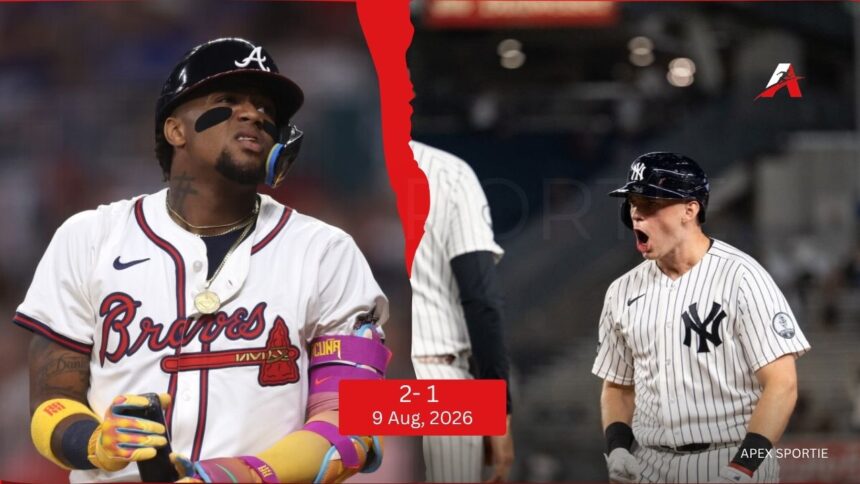
The Atlanta Braves delivered a dramatic 2–1 extra-inning victory over the New York Yankees on August 9, 2026, finishing the series finale with a decisive run in the 10th inning at Yankee Stadium. The game featured outstanding pitching, limited offensive opportunities, and several clutch defensive plays. Atlanta finished with only four hits, but one of those hits came at the perfect moment when Michael Harris II produced the go-ahead single in the 10th. New York also collected four hits but could not generate the late offense needed to complete another comeback.
The contest was largely controlled by the starting pitchers. Atlanta’s Grant Holmes worked six scoreless innings, while Yankees starter Cam Schlittler went seven innings and struck out 11. Matt Olson gave the Braves their first run with a solo homer in the seventh, but Trent Grisham answered with a game-tying home run in the eighth. Raisel Iglesias and Tyler Kinley then closed the game for Atlanta, with Kinley recording the save in the bottom of the 10th.
A Low-Scoring Battle at Yankee Stadium
The opening six innings produced exactly the type of baseball expected from two teams with strong pitching staffs. Neither lineup could push a runner across, and the game remained scoreless until the seventh. Atlanta managed only three hits through the first seven innings, while New York struggled to turn its opportunities into productive at-bats. The final statistics reflected the tight nature of the contest, with both teams recording four hits and the Yankees committing the only error.
Atlanta’s defensive execution also played an important role. Matt Olson made an unassisted double play in the fifth inning, and Ronald Acuña Jr. made a clutch defensive play in the sixth to prevent New York from scoring. Those moments helped preserve the 0–0 deadlock and allowed the Braves to remain within one swing of taking the lead.
Opening Pitching Duel Sets the Tone
Grant Holmes opened the game for Atlanta and immediately established control. He completed six innings while allowing only three hits and two walks. Holmes did not surrender a run and struck out two Yankees, throwing 77 pitches. His ability to work through New York’s limited threats kept Atlanta in the game while the Braves waited for their offense to break through.
Cam Schlittler was even more dominant in terms of strikeouts. The Yankees right-hander completed seven innings, allowing three hits and one earned run without issuing a walk. He struck out 11 Braves on 96 pitches. Schlittler’s performance gave New York an excellent chance to win, but the lone run he allowed came from Matt Olson’s seventh-inning home run.
Grant Holmes Keeps the Yankees Quiet
Holmes deserves significant credit for establishing the foundation for Atlanta’s eventual victory. His six scoreless innings included three hits, two walks, and two strikeouts. More importantly, he avoided the big mistake against a Yankees lineup that could have changed the game with one extra-base hit or home run. His outing ensured that the Braves entered the late innings with the score still within reach.
The right-hander also benefited from strong defensive support. Atlanta turned two double plays, including Olson’s unassisted play in the fifth, while Acuña prevented a potential scoring opportunity in the sixth. Holmes did not receive a decision, but his performance was one of the central reasons Atlanta was able to win the game despite producing limited offense.
Cam Schlittler Delivers a Strikeout Masterclass
Schlittler produced arguably the most dominant individual pitching line of the afternoon. Seven innings, three hits, one earned run, zero walks, and 11 strikeouts is an outstanding performance, particularly against an Atlanta lineup featuring players such as Ronald Acuña Jr. and Matt Olson. He kept the Braves from building sustained pressure and finished his outing with the Yankees trailing only 1–0.
The main problem for New York was that Schlittler’s excellent work did not receive enough offensive support. The Yankees managed only four total hits, and their lone run came from Trent Grisham’s eighth-inning home run. Schlittler left after seven innings, and Atlanta eventually scored against Paul Blackburn in the 10th, turning a strong pitching performance into a no-decision.
Matt Olson Breaks the Scoreless Deadlock
Matt Olson finally broke the stalemate in the top of the seventh. Facing Schlittler, Olson launched his 34th home run of the season, giving Atlanta a 1–0 advantage. It was Atlanta’s first run and one of only two runs the Braves would score during the entire game.
Olson finished 1-for-4 with one run, one RBI, and one home run, while striking out three times. His performance illustrates the importance of power in a low-scoring contest. Even though Atlanta collected only four hits overall, Olson’s solo shot temporarily gave the Braves control and forced New York to respond.
Trent Grisham Answers With a Home Run
New York responded in the bottom of the eighth. Trent Grisham connected for his 13th home run of the season, tying the score at 1–1. The homer came against Didier Fuentes and represented the Yankees’ first and only run of the game. Grisham’s blast also prevented Atlanta from protecting a one-run lead through the final two innings.
Grisham finished 1-for-4 with one run, one RBI, and a home run. His hit production was limited, but his contribution was critical because it restored a tie and gave the Yankees another opportunity to win in extra innings. Ultimately, however, New York could not produce the second clutch hit required to finish the comeback.
Michael Harris II Produces the Decisive Hit
The decisive moment arrived in the top of the 10th. With Atlanta looking for a breakthrough, Michael Harris II delivered a go-ahead single against Paul Blackburn. The hit brought home Atlanta’s automatic runner and moved the Braves ahead 2–1. MLB’s game recap identified Harris’s single as the key offensive play of the extra-inning victory.
Harris finished 1-for-4 with one RBI and two strikeouts. His overall line was modest, but his timing could not have been better. In a game where both teams produced only four hits, the value of a single in the 10th inning was enormous. Atlanta needed one successful at-bat, and Harris supplied it when the pressure was highest.
Atlanta’s Bullpen Handles the Pressure
Atlanta’s bullpen completed the job after Holmes departed. Dylan Dodd worked two-thirds of an inning without allowing a run, while Didier Fuentes recorded three strikeouts over 1⅓ innings but surrendered the tying homer to Grisham. Raisel Iglesias then delivered a crucial scoreless 10th inning with two strikeouts.
Tyler Kinley handled the bottom of the 10th and secured his first save of the season. He needed only 10 pitches to finish the inning, striking out one batter and allowing no hits or runs. Iglesias received the win after his perfect inning, while Kinley’s save officially completed Atlanta’s 2–1 victory.
Yankees Struggle to Convert Scoring Chances
New York’s offensive problem was not simply the number of hits. The Yankees repeatedly failed to turn their limited opportunities into runs. The club went 0-for-6 with runners in scoring position, leaving five runners on base. That lack of situational hitting became especially costly in a one-run game decided in extra innings.
Trent Grisham was the exception, producing the Yankees’ only RBI with his eighth-inning homer. Austin Wells collected a double, while Jazz Chisholm Jr. also recorded a hit. However, New York’s lineup could not generate the combination of baserunners and timely hits needed to support Schlittler’s outstanding start. The Yankees also committed one error, with Chisholm charged with the defensive mistake.
Braves Batting Performance Breakdown
Atlanta finished the game with four hits, led by Olson’s home run, Michael Harris II’s RBI single, Ozzie Albies’ single, and Mike Yastrzemski’s double. Yastrzemski went 1-for-3, while Albies went 1-for-4. The Braves did not generate a high-volume offensive attack, but their limited production came at critical moments.
The bottom half of the lineup struggled to make an impact. Dominic Smith went 0-for-4 with four strikeouts, while Austin Riley and Jim Jarvis also failed to record hits. Drake Baldwin and Acuña went hitless as well. That makes Atlanta’s victory even more notable because the team won despite getting very little production from several important spots in the order.
Yankees Batting Performance Breakdown
The Yankees also finished with only four hits. Grisham provided the biggest contribution with his home run, while Austin Wells recorded a double and Jazz Chisholm Jr. added a hit. The rest of the lineup struggled to produce consistent contact against Atlanta’s pitching staff.
Heliot Ramos and George Lombard Jr. both reached base during the contest but were unable to drive in runs. New York’s lack of success with runners in scoring position ultimately proved decisive. The Yankees had opportunities, but Atlanta’s pitching and defense repeatedly ended those threats before they could become multi-run innings.
Key Player Stats and Individual Performances
| Player | Team | Performance |
|---|---|---|
| Matt Olson | Braves | 1-for-4, 1 HR, 1 RBI |
| Michael Harris II | Braves | 1-for-4, 1 RBI |
| Mike Yastrzemski | Braves | 1-for-3, 1 double |
| Grant Holmes | Braves | 6 IP, 3 H, 0 R, 2 BB, 2 K |
| Raisel Iglesias | Braves | 1 IP, 0 H, 0 R, 2 K, Win |
| Tyler Kinley | Braves | 1 IP, 0 H, 0 R, 1 K, Save |
| Trent Grisham | Yankees | 1-for-4, 1 HR, 1 RBI |
| Austin Wells | Yankees | Double |
| Cam Schlittler | Yankees | 7 IP, 3 H, 1 ER, 0 BB, 11 K |
| Paul Blackburn | Yankees | 2 IP, 1 H, 1 R, 0 ER, 2 K |
These numbers show how closely matched the teams were. Both clubs produced four hits, but Atlanta had the more important hits. Olson’s home run created the first lead, Grisham immediately erased it, and Harris eventually delivered the game-winning hit. On the pitching side, Schlittler recorded the most strikeouts, while Holmes and the Braves’ late-inning relievers collectively kept New York’s offense under control.
The Tenth-Inning Turning Point
The 10th inning separated the two teams after nearly nine innings of tightly contested baseball. Harris’s single put Atlanta ahead 2–1, and the Braves then added pressure by forcing a strike-’em-out, throw-’em-out double play. That defensive sequence helped prevent the Yankees from extending the inning and gave Atlanta’s bullpen the opportunity to protect the lead.
The Yankees still had a final opportunity in the bottom of the 10th because of the automatic runner rule. However, Kinley shut down the threat before New York could tie the game. His clean inning preserved the narrow advantage and gave Atlanta a memorable extra-inning victory in the Bronx.
What the 2–1 Result Means
The victory moved Atlanta to 71–47, while New York dropped to 66–52 following the series finale. The Braves had entered the game after losing the previous two contests of the series, including a 5–4 Yankees victory on August 8. Atlanta therefore avoided a sweep by winning the final game in dramatic fashion.
For the Yankees, the defeat highlighted how narrow the margin can be against a strong opponent. Schlittler delivered seven outstanding innings, but the offense produced only one run. New York also went hitless in six at-bats with runners in scoring position. Those numbers made the loss particularly frustrating because the pitching staff did enough to put the Yankees in position to win.
Conclusion
The Atlanta Braves vs New York Yankees Match Player Stats from August 9, 2026, tell the story of an intense pitching battle decided by a handful of clutch moments. Grant Holmes kept Atlanta in the contest with six scoreless innings, while Cam Schlittler produced 11 strikeouts across seven dominant innings. Matt Olson’s solo homer opened the scoring, Trent Grisham answered for New York, and Michael Harris II ultimately delivered the decisive hit in the 10th.
Atlanta’s 2–1 extra-inning victory demonstrated the importance of timely hitting, defensive execution, and bullpen reliability. The Braves managed only four hits, but their biggest offensive plays arrived when they mattered most. New York also recorded four hits but went 0-for-6 with runners in scoring position. In a game decided by one run, that difference proved decisive and gave Atlanta a dramatic series-ending win at Yankee Stadium.
VISIT MORE: APEX SPORTIE