
The clash between the 49ers vs Seahawks Match Player Stats on January 17, 2026, turned into a one-sided contest dominated by Seattle. With a final score of 41-6, the Seahawks delivered a commanding performance on both offense and defense, leaving little room for a comeback.
This full game breakdown analyzes player stats, team performance, and key moments that shaped the outcome. From Seattle’s efficient red zone execution to San Francisco’s struggles with turnovers, every stat explains how the game unfolded.
Final Score Breakdown and Key Highlights
| Team | Q1 | Q2 | Q3 | Q4 | Final |
|---|---|---|---|---|---|
| San Francisco 49ers | 0 | 6 | 0 | 0 | 6 |
| Seattle Seahawks | 17 | 7 | 10 | 7 | 41 |
Final Score Breakdown and Game Flow
Seattle set the tone early, scoring 17 points in the first quarter while completely shutting down San Francisco. The 49ers failed to respond offensively, going scoreless in the first half as the Seahawks added another 7 points in the second quarter.
The second half followed a similar pattern, with Seattle continuing to dominate. They scored 10 points in the third quarter and closed the game with 7 more in the fourth. San Francisco managed only 6 points, all coming in the second quarter, highlighting their offensive struggles throughout the game.
Team Stats Comparison
| Category | San Francisco 49ers | Seattle Seahawks |
|---|---|---|
| 1st Downs | 15 | 19 |
| Passing 1st downs | 10 | 7 |
| Rushing 1st downs | 5 | 10 |
| 1st downs from penalties | 0 | 2 |
| 3rd down efficiency | 6-12 | 4-10 |
| 4th down efficiency | 0-3 | 0-0 |
| Total Plays | 60 | 52 |
| Total Yards | 236 | 281 |
| Total Drives | 11 | 10 |
| Yards per Play | 3.9 | 5.4 |
| Passing | 128 | 106 |
| Comp/Att | 17/31 | 12/17 |
| Yards per pass | 3.9 | 5.6 |
| Interceptions thrown | 1 | 0 |
| Sacks-Yards Lost | 2-16 | 2-18 |
| Rushing | 108 | 175 |
| Rushing Attempts | 27 | 33 |
| Yards per rush | 4.0 | 5.3 |
| Red Zone (Made-Att) | 0-0 | 4-6 |
| Penalties | 3-36 | 2-5 |
| Turnovers | 3 | 0 |
| Fumbles lost | 2 | 0 |
| Interceptions thrown | 1 | 0 |
| Defensive / Special Teams TDs | 0 | 1 |
| Possession | 28:49 | 31:11 |
Overall Team Performance Comparison
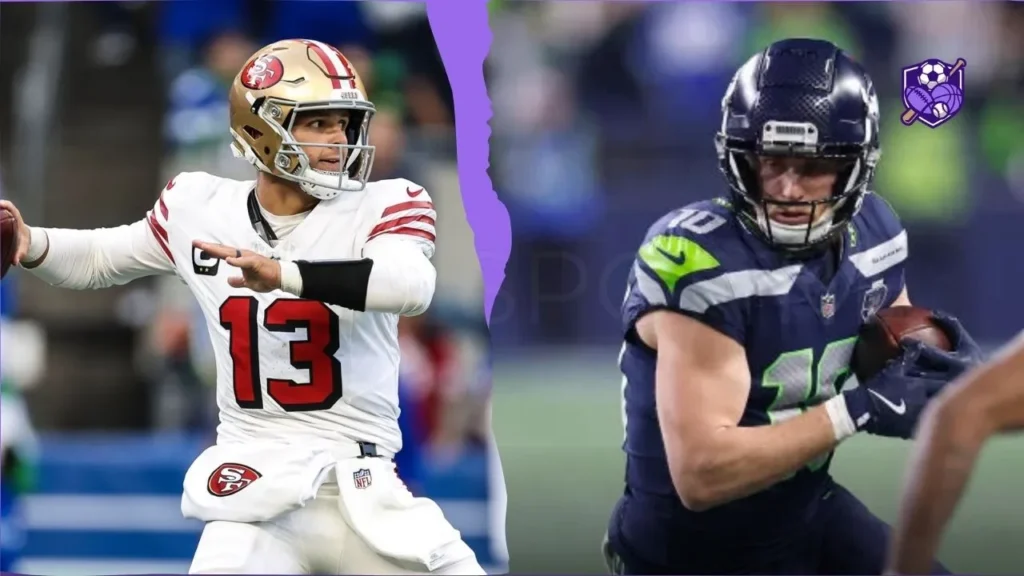
Seattle outperformed San Francisco in nearly every statistical category. They recorded 281 total yards compared to the 49ers’ 236 and averaged a stronger 5.4 yards per play. Their balanced attack and consistent execution made a clear difference.
San Francisco, despite running more plays, failed to convert opportunities into points. Their lower efficiency and inability to capitalize on drives reflected a lack of offensive rhythm. Seattle’s control and discipline defined the overall performance.
First Downs and Offensive Efficiency
The Seahawks led in first downs with 19 compared to the 49ers’ 15. Their ability to gain yards consistently allowed them to sustain drives and keep their offense on the field.
San Francisco showed some balance with 10 passing and 5 rushing first downs but lacked consistency. Seattle’s combination of rushing and passing efficiency gave them a clear advantage in maintaining offensive momentum.
Third and Fourth Down Conversions
San Francisco actually performed better on third downs, converting 6 out of 12 attempts. Seattle converted 4 out of 10, showing moderate efficiency.
However, the difference came in execution beyond third downs. The 49ers failed on all three fourth-down attempts, while Seattle did not need to rely on risky plays. This highlights how situational efficiency matters more than raw conversion numbers.
Total Yards and Offensive Output
Seattle’s 281 total yards came from a balanced offensive approach, allowing them to maintain control throughout the game. Their ability to distribute plays between rushing and passing kept the defense guessing.
San Francisco managed 236 yards but struggled to turn those yards into scoring opportunities. Their offensive output lacked explosiveness, and missed chances prevented them from staying competitive.
Passing Game Breakdown
The 49ers recorded 128 passing yards with 17 completions on 31 attempts. However, their average of just 3.9 yards per pass shows a lack of big plays and downfield success.
Seattle had 106 passing yards but was more efficient, averaging 5.6 yards per pass with fewer attempts. While not dominant through the air, their passing game complemented their rushing attack effectively.
Rushing Performance Analysis
Seattle dominated the rushing game with 175 yards on 33 attempts, averaging 5.3 yards per carry. This strong ground performance allowed them to control the clock and maintain offensive balance.
San Francisco recorded 108 rushing yards on 27 attempts, averaging 4.0 yards per carry. While decent, it was not enough to compete with Seattle’s more productive rushing attack.
Red Zone Efficiency
One of the biggest differences in the game was red zone performance. Seattle converted 4 out of 6 opportunities into touchdowns, showing strong execution when it mattered most.
San Francisco failed to score on all of their red zone attempts, going 0 for 0. This inability to capitalize on scoring opportunities played a major role in their low point total.
Turnovers and Defensive Impact
Turnovers were a critical factor in this matchup. The 49ers committed 3 turnovers, including 2 lost fumbles and 1 interception, which disrupted their offensive flow.
Seattle, on the other hand, had zero turnovers and even added a defensive touchdown. This defensive contribution further widened the gap and highlighted their dominance on both sides of the ball.
Time of Possession and Game Control
Seattle controlled possession with 31 minutes and 11 seconds compared to San Francisco’s 28 minutes and 49 seconds. While the difference is not huge, it reflects Seattle’s ability to sustain drives.
San Francisco’s turnovers and failed fourth-down attempts limited their effective possession. Seattle’s control of the clock helped them maintain momentum and dictate the pace of the game.
Key Player Contributions
Seattle’s offense benefited from a strong rushing unit that consistently gained yards and controlled the tempo. Their defense also played a crucial role, forcing turnovers and even scoring a touchdown.
San Francisco struggled to find standout performers, as their offense lacked rhythm and consistency. While some players showed effort, the overall team performance fell short against a dominant Seattle side.
Key Moments That Defined the Game
The first quarter was a defining moment, as Seattle’s 17-0 lead set the tone early. This forced San Francisco into a defensive position for the rest of the game.
Another key moment was the defensive touchdown by Seattle, which further extended their lead and crushed any hopes of a comeback. These moments highlight how early dominance and defensive impact can shape a game.
Conclusion
The San Francisco 49ers vs Seattle Seahawks matchup on January 17, 2026, was a clear demonstration of dominance by Seattle. Their balanced offense, strong rushing game, and disciplined defense led to a convincing 41-6 victory.
San Francisco struggled with turnovers, red zone inefficiency, and lack of offensive production. This game serves as a reminder that execution in key moments is essential for success in the NFL.
Frequently Asked Questions
Who won the 49ers vs Seahawks game on Jan 17, 2026?
The Seattle Seahawks won the game with a final score of 41-6.
What was the key factor in Seattle’s win?
Strong rushing performance, zero turnovers, and excellent red zone efficiency were key factors.
How did the 49ers perform offensively?
They struggled, scoring only 6 points and failing to convert in the red zone.
Who dominated the rushing game?
Seattle led with 175 rushing yards compared to San Francisco’s 108.
Did turnovers impact the game?
Yes, the 49ers’ three turnovers significantly affected their chances.
VISIT MORE: APEX SPORTIE